
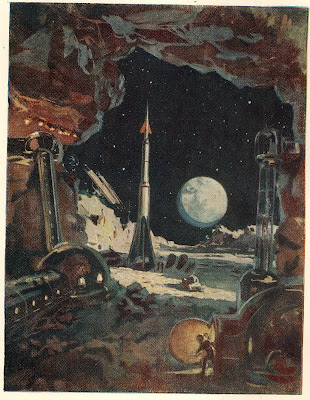
OK again I have a beautiful book: To Other Planets by Pavel Klushantsev. Art by Voishvillo, E. (My helpful readers chimed in on this one to help me out.)
This may be my favorite Russian book in terms of illustrations. Until I got this copy I only knew of it from the 1962 Hebrew translation I had found a number of years ago (I had even less luck translating that title).
 But the illustrations were the same and I knew I had found a winner. This is the gold medal of space books. Tons and tons of full color illustrations showing children how man will go to space and what it will look like. Of course it starts off explaining about rockets and showing their launch.


From here it talks about launching a space station and heading towards the moon. The space station illustration seems an "interpretation " of the Fred Freeman illustration from the 1954-1956 Collier's series but has its own Russian slant.
I am still not sure how space station designers got the idea for have a 3 prong stations. Two or four makes sense for balance but the 3 prong was developed for the Disney programs so they would not impinge on the Collier's design copyright. They seemed to have corrected that flaw in this illustration.
 They laid out the idea for a moon trip in an elegant series of drawings that make the whole mission seems very easy. In 1959 it seemed to every child that we were just a few steps from standing on the Moon.


 For the "fans" of spaceflight this was a vindication of their dreaming and prodding of others to make rockets real. It took rockets as a weapon to get people to build improved ones, but it was the ability to put something in orbit that was encouraged by these visionaries. There are very few military reasons to bother putting something in orbit but a whole bunch of scientific and creative ones.
 This is a 82 page pamphlet about Tsiolkovsky. Part of a classroom series for younger readers.


 From our vacation on Mars :)

 Illustration from these books look very similar to those from 10 years later. Astronauts in launch couches and weightless explorers in earth orbit filled these books.
 A landing on the Moon was a foregone conclusion. I particular like this book which predicted robot explorers getting there first.
 But almost all of these books show this image. Men standing on the Moon next to their spaceship. The rockets were all traditonal V-2 shaped but the illustrations often gave the sense that this was not the first visit but rather one of many.


 In addition to telling children how the world would change, there is a lot of inspirational power in showing children doing these activities. Showing children on the Moon sticks with them a lot more than just telling about the possibilities.


