Friday, April 24, 2020

The Authentic Book of Space (1954)


First came Authentic Science Fiction as a monthly magazine of both science fiction and science fact articles. Then came a British annual for children taking advantage of the trend towards space subject in books.

Edited by H.J. Campbell ; foreword by Arthur C. Clarke. Authentic Science Fiction.  London. (100 pp.),28 cm.


 A amazing treasure of the early British space literature, the contents are a mixture of articles and fictional stories by science fiction writers associated with the British Interplanetary Society (B.I.S.) and the London Science Fiction Circle. 


 This copy was signed by one of the great American SF Collectors and occasional writer, Forrest J. Ackerman.


It has a number of interesting articles about the history of rockets, navigating rockets, a reprint of a B.I.S. paper on artificial satellites, and how to communicate with aliens. Also the usual comic strips, puzzles, and various games. 

Friday, April 17, 2020

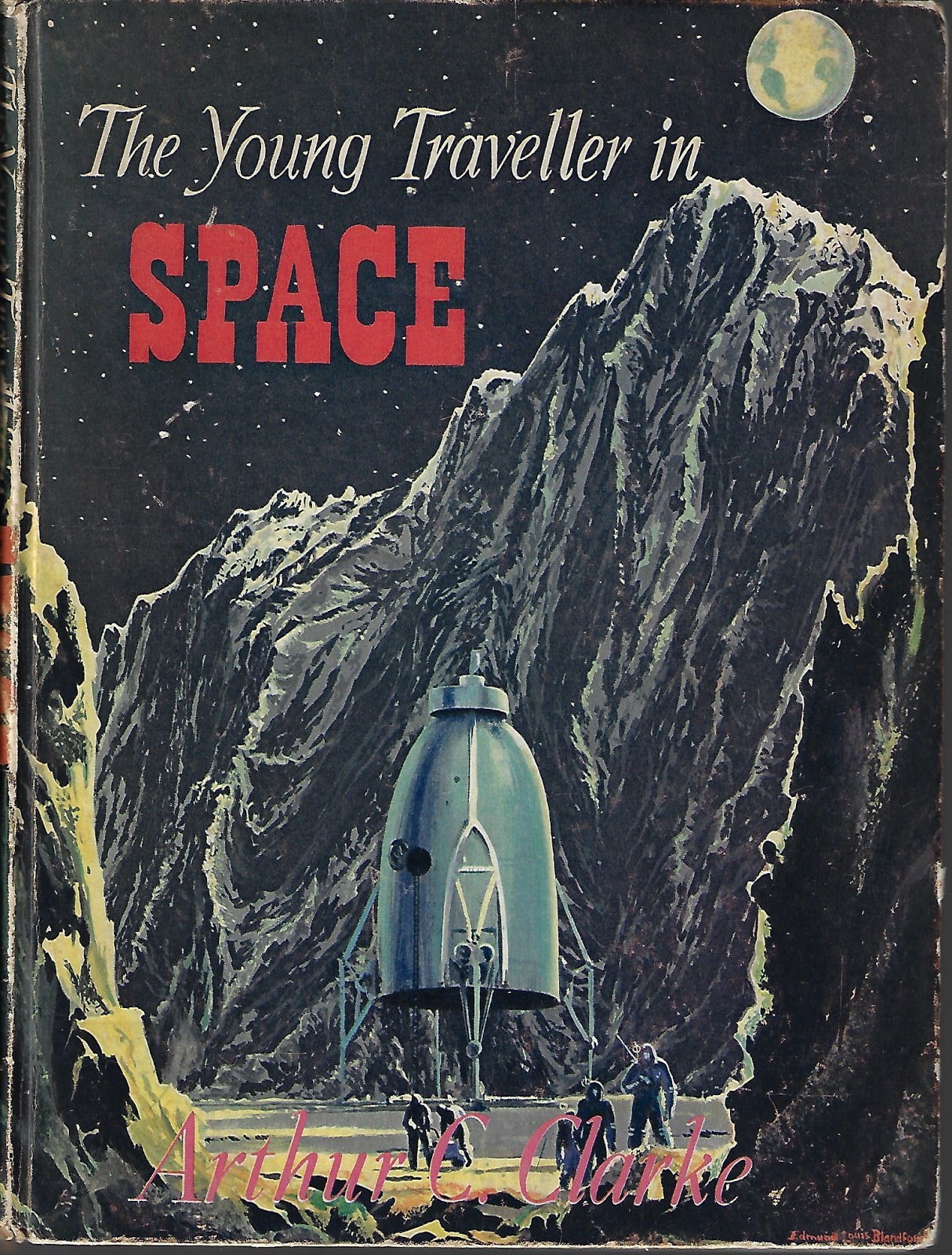
The Young Traveler in Space (1954)


With all the strangeness going on and having to work from home I am going to go back to my favorites. So this is the first in re-scanning some books that I have shared before over the last 10 or so years. I hope these still bring you as much joy and they do me.

Arthur C. Clarke. The Young Traveler in Space. Illustrated by Edmund Blandford, G.A. Frodsham and R.A. Smith. London : Phoenix House. (72 pp.) 28 cm.

This was Arthur C. Clarke's children's book to teach about spaceflight.
It was a basic book about the history of thought about spaceflight, basic principles of rockets and a explanation how we would get to the Moon and the planets.


 As the man who basically first put forward in print the idea of communication satellites, this diagram above is almost historic in showing and explaining this idea to children.


 There were many ideas about what a space station would look like but it was always promoted as the first part of our "steps to the planets."

 The next step was the Moon. This "vision" was based on plans developed by the British Interplanetary Society (BIS) and was illustrated by the best of the early British space artists, R.A. Smith.


This last photograph was part of the exploring the planets section. It was not clear exactly what it would look like but "space domes" were always thought to be a part of it.

Friday, April 10, 2020

Chick-Chick Easter Egg Space Color Kit (1966)


So to celebrate Easter this year I have been saving this item that I bought just after Easter in 2019. Back when the earth was new there appeared coloring kits for Easter eggs. Instead of vinegar and food coloring there were "kits" that your parents would buy. In 1966 there was a space-based Chick-Chick kit designed around a U.S.A. space station and the planets.

 Observe the rocket, satellites, space station and descending space capsule on the side of the box.
 The key to this "space shot" was the space station platform you could build to hold your decorated eggs.
 The platform and the space station had punchouts with facts about the planets.
 Alas poor Pluto was left out again from the list of planets (a premonition of the future?)
It also came with two coloring books, that you could color and enter a contest. The first (above) was rather generic, the second was this one:


You could win a bicycle if you could color imaginatively enough!

Happy Easter to you all.


Friday, March 27, 2020

We, Too (1963)


A nice children's book about dreaming of a flight into space.

V. Dragunsky. Illustrated by I. Kononov. We, Too. Moscow: Children's World. (28 p.) 28 cm. 1963.


 Planning the rocket and getting the materials


Building the rocket they will play in.


Friday, March 20, 2020

We Fly to the Moon (1961)


 We Fly to the Moon is a wonderfully unique pop-up book from Russia. The paper pop-ups give shape to some lovely ideas.

G. Yurmin. Drawn by Y. Bugelsky. We Fly to the Moon. Moscow : Children's world. (10 p.) 28 cm. 1961


 Balloon


 Moon in the sky


 Rocket


 Going to Mars or maybe just a view of Mars from Earth

I think the rocket ship in the back cover folded out too, but it was too damaged to try.


Friday, March 13, 2020

Russian Children's Magazine (1961)


Sorry I don't have a translation on this. I bought it a while ago and have no more information.

It is number 8 in 1961 (maybe August?).  I just enjoyed a couple of the illustrations that seemed worth sharing.


 There was a nice illustration of a fictional story on the back cover.
 The best was a cut-out illustration of a space rocket.


Here is your finished rocket.

Friday, March 6, 2020

The Man-Rocket (1961)


So this is just a fun bit of ephemera.  Everyone characterizes the space age as "Where's my jetpack?" This was shorthand for the promised wonders of the time. But some of those ideas were pretty awesome!

The rocket belt  was a real technology that was demonstrated widely at the World's Fair in 1961. This pamphlet from Bell  Aerosystems Company showed some of the wonders and science behind it.


In 2009 I blogged about Kornel Keds and His Exciting Bell Rocket Belt


ROCKET BELTS ON THE MOON!!!